Keep the meter running
Goal: the meter on every Claude Code prompt — model, cost so far, burn rate — without running a command yourself.
aireceipts statusline prints exactly one line, meant to be wired into Claude Code's statusLine config:
[aireceipts] Opus · $4.20 · $9/hr · 128k · ctx 42% · 5h 24% ↺2h13m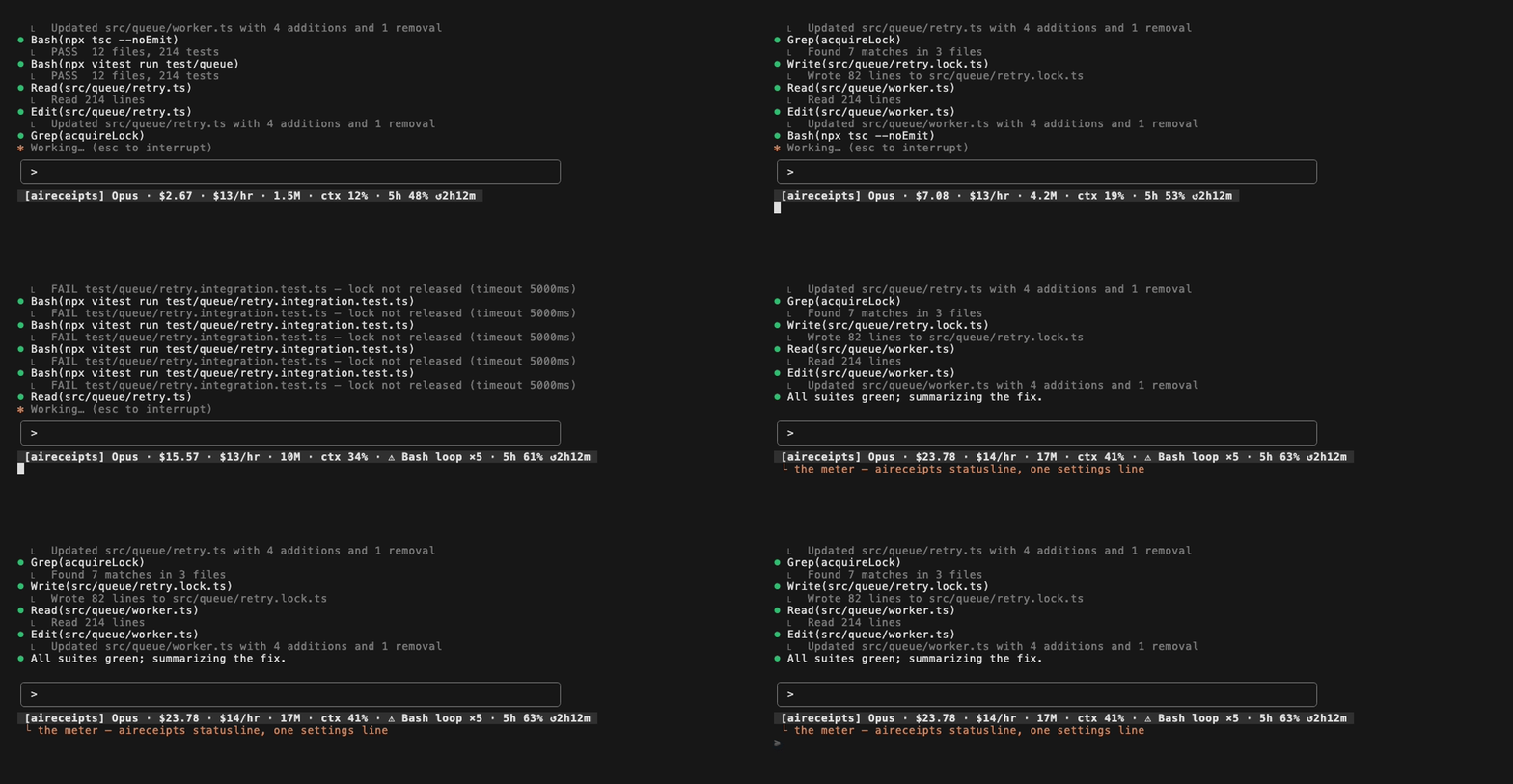
Set it up
Add a statusLine block to your Claude Code settings.json — global (~/.claude/settings.json) or project-local (.claude/settings.json):
{
  "statusLine": {
    "type": "command",
    "command": "aireceipts statusline"
  }
}
Claude Code runs that command on its own schedule and pipes a small JSON payload on stdin — including the transcript_path of the active session. aireceipts reads that payload, prices the referenced transcript, and prints the line. No polling, no daemon, one disk read per invocation.
If aireceipts isn't on your PATH, put the absolute path (the output of which aireceipts) in the command field.
In tmux or another shell (Codex, opencode)
The statusline is not Claude-Code-only. Any terminal surface that can run a command shows it — which is how Codex and opencode sessions get a live cost line. With aireceipts installed globally, add to ~/.tmux.conf:
set -g status-right '#(aireceipts statusline --cwd "#{pane_current_path}")'Each pane shows its own session's cost. To get the bar automatically every time you launch the agent — without living in tmux full-time — see the shell-wrapper recipe (a codex() function that starts tmux on demand). Starship, raw zsh/bash, PowerShell, and OSC terminal-title recipes — plus the path-matching rules — are in the terminal-surfaces reference. For Claude Code itself, the native stdin hook above stays the richer, recommended setup.
What the line shows
The default line is the segment set brand,model,cost,burn,tokens,context,waste,quota5h — the model, cost, burn rate, tokens, context fullness, a waste flag, and your rate-limit window:
Opus(after the brand) is the model — in stdin mode, Claude Code's own current model name (a mid-session switch shows on the next render); in disk fallback, the session's dominant model by token share. Omitted when neither is known.$X.XXis the session's priced cost (Nk/NMtokens alone when it can't be priced — never a fabricated dollar amount), and$X/hrits session-average burn rate.ctx N%is how full the current context window is; token counts abbreviate tok/M(128k,1.2M).5h N% ↺Xh Ymis your official 5-hour rate-limit usage plus the time until it resets — subscribers only, on by default, and dropped when Claude Code doesn't provide it.- A waste flag (
⚠ Bash loop ×5) appears only when a detector actually fired. - Outside a piped call, or when the payload carries no session, it falls back to the newest session on disk, and prints a neutral placeholder rather than an error if there are none — so your statusline layout never breaks.
Pick your own segments with --format; the full segment table and the ≈ quota ETA honesty rules are in docs/statusline.md.
Rate-limit window (--quota)
If you're on a Claude Code subscription, aireceipts --quota reports your current rate-limit window when Claude Code provides it on stdin. It runs in statusline stdin mode only and stays silent when that data isn't available, so it's safe to include in a statusline command that also prints cost.
Full reference
The authoritative statusline reference — every output shape and fallback — is docs/statusline.md.
Next
- Install the agent hook — a full receipt at session end.
- Set a budget — a threshold, not just a number.